Chapter 5
Safe Driving Practices
Part of the English Reference Edition (Version 1.0a)
This online chapter is part of the complete Driver's Guide for India. The complete guide and Indian-language translations are available from the manuals page.
Safe driving is about creating peace of mind — for you and for
everyone around you. Safe driving is not only about obeying laws and
passing a test. It is a philosophy of how one approaches the road. A
safe driver is someone who understands that every decision behind the
wheel has consequences, not only for themselves, but for passengers,
pedestrians, and other road users. Safe driving creates an atmosphere of
trust—trust that others will follow the rules, that vehicles will act
predictably, and that danger will be minimized.
India’s roads are among the busiest and most varied in the world, with
vehicles ranging from trucks and buses to two-wheelers, bicycles,
animal-drawn carts, and pedestrians. In such an environment, safe
driving practices are not just desirable—they are essential. The more
drivers commit to safe practices, the fewer accidents occur, the
smoother traffic becomes, and the more pleasant the road experience is
for everyone.
Defensive driving is the practice of anticipating hazards and preparing yourself to respond safely so that one mistake—either yours or someone else's—does not lead to disaster.
| Golden Rule of Sharing the Road: Drive as though every other road user’s safety depends on you. If every driver shows patience and courtesy, accidents can be prevented. A defensive driver is always alert, always patient, and never surprised. |
|---|
Defensive driving is an important concept in driving. Defensive driving is about expecting the unexpected and staying prepared so that a single mistake — either yours or someone else’s — does not result in an accident. A true defensive driver creates a buffer of safety around themselves and others, ensuring that at least two mistakes would have to happen before a collision occurs.
The South African K53 system offers a clear way to understand defensive driving, built on the cycle of:
SEARCH → IDENTIFY → PREDICT → DECIDE → EXECUTE
Search: Continuously scan the road ahead, behind, and to the sides. Look for hazards such as pedestrians about to cross, cyclists weaving, or a car braking suddenly.
Identify: Recognize which of those hazards are most likely to affect you. For example, a parked truck blocking visibility at an intersection.
Predict: Think ahead — what might happen next? Could the child on the footpath run into the road? Might the car in the right lane cut across suddenly?
Decide: Choose the safest response in advance — slow down, hold your lane, prepare to brake, or signal to change lanes.
Execute: Carry out your decision smoothly and confidently, avoiding sudden or panicked moves.
Practical reminders include:
Maintain a safe following distance, using the two-second rule in normal conditions and doubling it in rain, fog, or poor visibility.
Anticipate that other road users may make mistakes — pedestrians may cross carelessly, cyclists may swerve, or drivers may jump signals.
Do not assume you have been seen; judiciously use your horn, lights, and indicators to make your presence clear.
Always leave yourself an “escape path” — a clear option to move safely if traffic ahead comes to a sudden stop.
Example: In a busy Indian market street, a defensive driver scans for pedestrians stepping off the curb, anticipates two-wheelers weaving through traffic, and slows down near unmarked speed breakers, ensuring they can stop if a child darts into the road.
Rationale: Defensive driving is not about fear but about foresight. By searching, identifying, predicting, deciding, and executing calmly, you give yourself and others the best chance to avoid accidents.
Every driver carries personal attitudes onto the road — confidence, impatience, competitiveness, or fatigue — and these influence decisions made in the moment. In driving, as in aviation, most errors arise not from lack of skill but from poor judgment under stress or haste. Recognizing one’s own tendencies is the first defense against them.
Impulsiveness — acting too quickly without thinking, such as overtaking on a curve.
Resignation — giving up responsibility (“nothing I do matters”), which reduces alertness.
Invulnerability — assuming “it won’t happen to me,” which erodes caution.
Macho attitude — trying to prove skill or dominance instead of focusing on safety.
Good drivers pause before reacting, stay mindful of their emotional state, and make deliberate, calm choices. Awareness of attitude is the foundation of safe decision-making.
Rationale: Recognizing how emotions influence judgment helps prevent overconfidence, anger, and risk-taking on the road.
India’s roads are public spaces used by many different kinds of
vehicles and people. Cars, scooters, auto-rickshaws, bicycles, bullock
carts, buses, trucks, and pedestrians all share the same limited space.
Every road user, from pedestrians to trucks, has the same right to
safety. Safe driving practices demand respect for all road users,
regardless of size, speed, or power.
Key points to remember:
Pedestrians: They are the most vulnerable. Always stop for them at crossings and be extra careful near schools, markets, or bus stops.
Two-wheelers and bicycles are smaller and less visible than cars, especially at night. Always give them extra space, especially when turning or changing lanes, as they often fall completely into a car's blind spot, and because even a slight touch or close pass can cause them to lose balance and fall.
Heavy vehicles: Trucks and buses require longer distances to stop and have wide blind spots. Do not cut abruptly in front of them or linger alongside them.
Animal-drawn or slow-moving vehicles: They may seem inconvenient, but they have as much right to the road as you do. Show patience and overtake safely.
Stray animals: Cattle, dogs, or other animals may cross roads unexpectedly, especially in rural areas or near markets. Slow down and use the horn lightly to alert them without startling.
Rationale: Roads are shared resources. Treating weaker users with courtesy and care prevents tragedies and builds a culture of mutual respect.
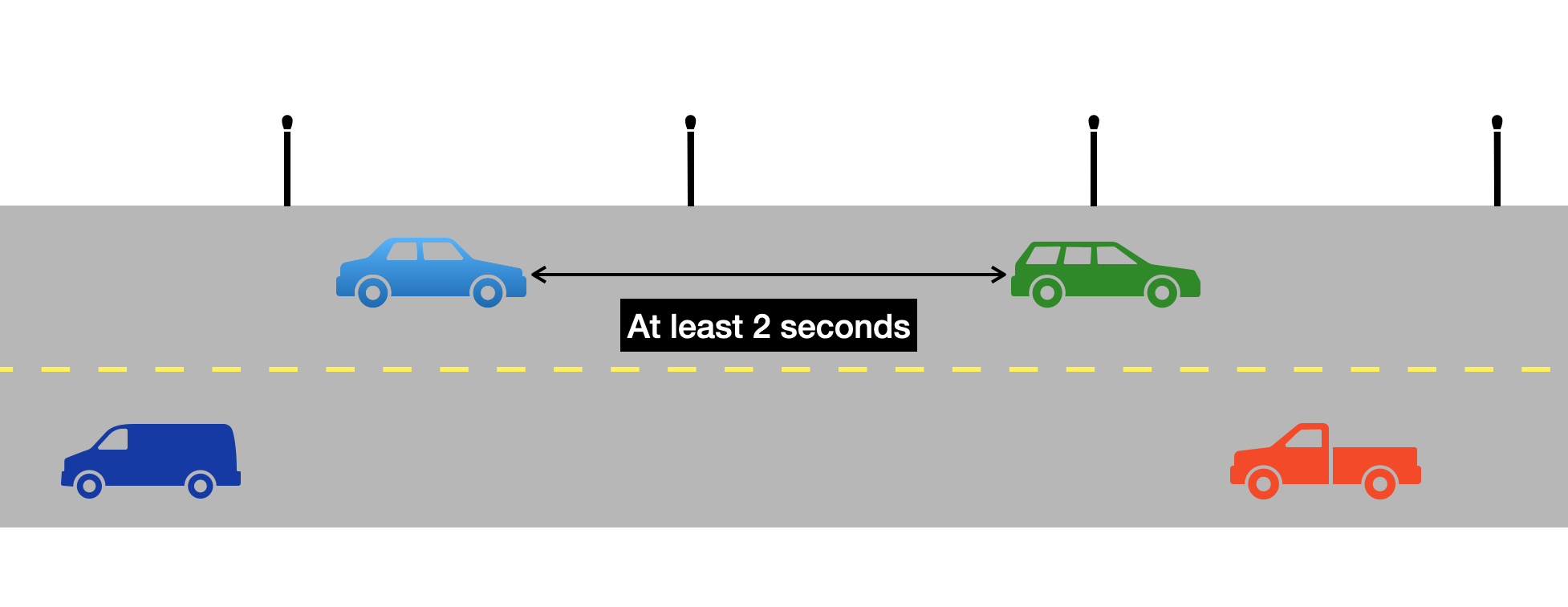
Keeping distance from the vehicle ahead is one of the simplest and most effective safety habits. Distance gives you time, and time gives you choices. Remember, the space needed is more than just braking distance; it is the Total Stopping Distance (Reaction Time + Braking Distance). The two-second rule accounts for both. Without enough space, even the best driver cannot avoid a crash if the vehicle in front stops suddenly.
A good rule is the two-second rule:
• Pick a marker on the road, such as a tree, sign, or lamp post.
• When the vehicle ahead passes it, start counting: “one thousand and one, one thousand and two.”
• If you reach the marker before you finish counting, you are too close — ease off and create more space.
Figure 9: Two second rule: Follow two or more seconds behind.
In poor conditions (e.g., rain, fog, or rough roads), increase the two-second rule to three or four seconds. For heavy vehicles like trucks or buses, use a four-second rule or more, as their stopping distances are significantly longer due to weight and momentum.
Remember: Tailgating (closely following another vehicle) is dangerous, and no one gains time from it. A safe distance feels generous, but it is actually just enough to protect you, your passengers, and those ahead. If someone is following too closely behind you, increase the distance in front of you and the vehicle ahead of you to allow for safe stopping distance for both you and the tailgater. You can also gently slow down and allow the tailgater to overtake you.
Rationale: Think of distance as buying yourself time — the most valuable safety tool you have.
Mirrors and indicators are the driver’s language of communication. Driving safely requires not just controlling your own vehicle but also signaling your intentions clearly to others. Using mirrors properly means checking them regularly, not only when changing lanes. Indicators should always be used when turning, merging, or overtaking, and they must be turned on early enough for others to react. The blind spot (Figure 10) is the area that cannot be seen in the driver’s mirrors. Before changing lanes, a quick head check (shoulder check) is mandatory to clear this area. This sequence should become routine practice: Check mirrors → Check blind spot → Signal → Move → Cancel Signal.
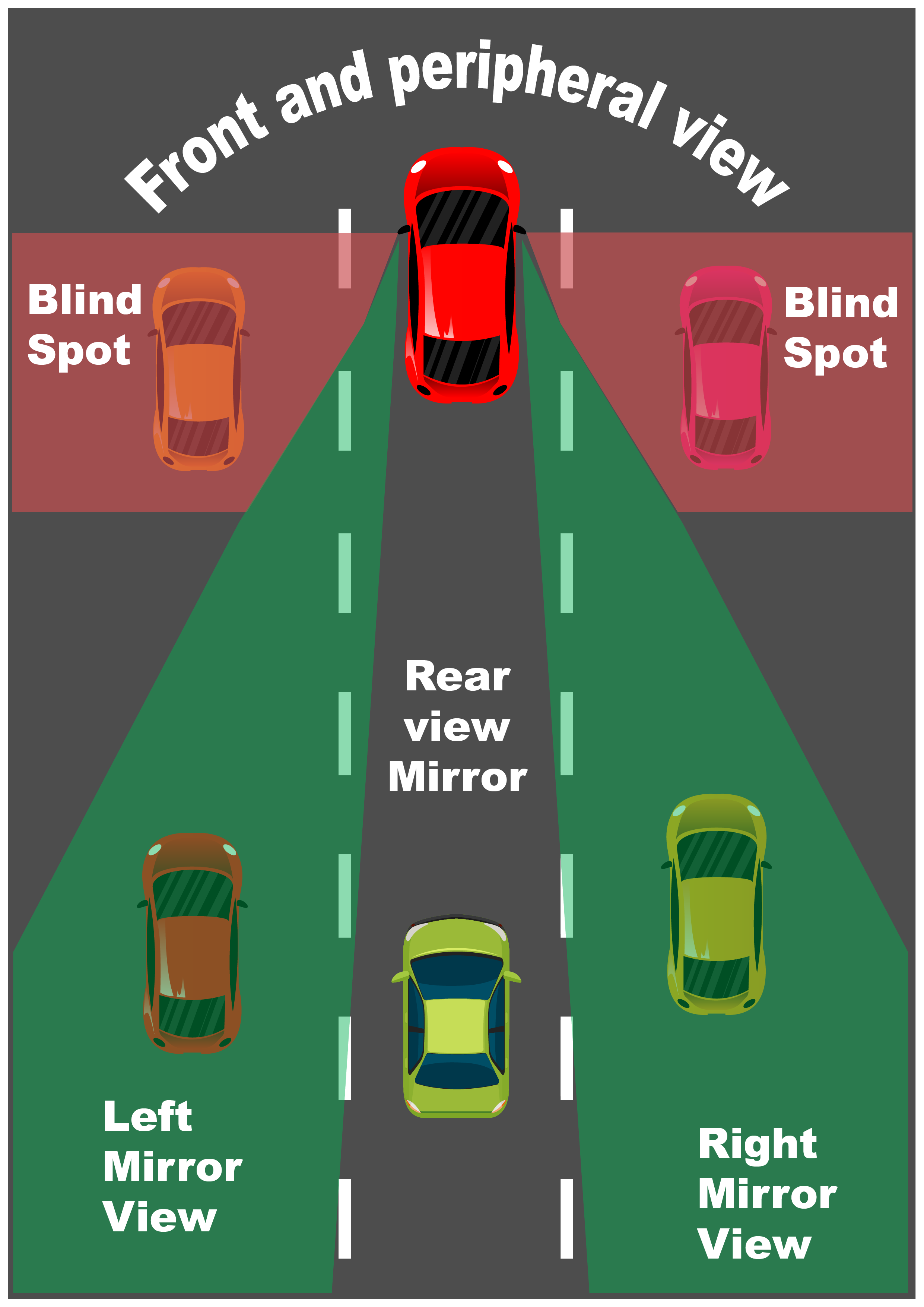
Figure 10: Vehicle blind spots: The driver cannot see in this area - Caution is advised.
Rationale: Predictability is the foundation of safe driving. If others know what you intend to do, they can adjust their own actions. Without communication, every maneuver becomes a surprise, which is a recipe for accidents.
India’s roads change with weather, time, and place — safe drivers adjust their habits to match. What works on a sunny, dry highway may be risky in heavy rain, at night, or on a steep hill.
Rain: Roads become slippery, especially just after the first rainfall when oil and dust mix with water. Slow down, keep a longer distance, and use headlights so you can be seen. Avoid sudden braking or sharp turns.
Fog: Visibility can drop suddenly. Use fog lights or low-beam headlights (never high beam, which reflects back). Drive slowly, and keep extra distance. Use hazard lights only if you are stopped.
Night: Darkness reduces visibility and depth perception. Lower speeds, clean windshields, and properly aimed headlights make a big difference. Watch for pedestrians, animals, or unlit vehicles.
Hills and Curves: Climb and descend in a low gear to maintain control. Always give way to vehicles coming uphill. Sound your horn on blind curves to alert oncoming traffic.
Rural Roads: Expect pedestrians, animals, tractors, and cyclists sharing the road. Be patient and avoid sudden maneuvers.
Unmarked or poorly lit roads: Common in rural and semi-urban areas, these require slower speeds and heightened vigilance for pedestrians, animals, or sudden obstacles. Use low-beam headlights and sound the horn lightly at blind corners.
Urban Congestion: Anticipate sudden stops, parked vehicles, and pedestrians crossing. Courtesy and patience prevent gridlock.
Rationale: Road conditions are never under your control — but how you adapt to them is. Safe drivers treat every condition as a reason to be more alert, not more aggressive.
Modern vehicles are filled with potential distractions: phones, music systems, GPS screens. Drivers must discipline themselves to focus on the road. Key practices include:
Never use a mobile phone without hands-free, and even then only for brief, necessary calls.
Set music, climate controls, and navigation before you start moving.
Avoid eating or smoking while driving.
Rest if tired—fatigue slows reaction time as much as alcohol.
A driver’s attention is their greatest safety tool — but it is also the easiest to lose. Distractions, even for a second, can turn a safe journey into a tragedy. Looking away at the wrong moment means you are not fully in control of your vehicle.
Common distractions include:
Mobile phones: Talking, texting, or checking apps takes eyes off the road and mind off driving. Even hands-free use reduces concentration.
Passengers: Conversations, children, or arguments can pull your focus away from the road.
Entertainment systems: Adjusting music or screens while driving divides attention.
Eating or drinking: Simple actions can take both hands and eyes away from the task.
The solution is simple: keep driving your only task. If something urgent arises, pull over safely before attending to it. Using a mobile phone while driving is illegal under Section 184 of the Motor Vehicles Act, with large fines even for the first offence. Prioritize safety over connectivity to avoid penalties and accidents.
Modern life makes phones and constant connection tempting, but nothing on your screen is more important than the road ahead.
Rationale: Your phone can wait — life cannot. A distracted driver travels blind, even if their eyes are open. Attention is your greatest safety tool.
Safe speed is not the same as maximum posted speed. Good drivers
adjust their pace based on the law, conditions, and their own comfort.
Going too fast reduces control; going too slow in fast-moving traffic
can also cause accidents.
Rationale: You must always be able to stop within the distance you can
see. This principle applies equally to highways, city roads, and rural
tracks. Speed should never be treated as a contest.
Courtesy on the road is not weakness; it is strength. Civic sense
transforms chaotic traffic into cooperative movement. Examples
include:
- Allowing others to merge smoothly.
- Using the horn as a gentle signal, not as a weapon.
- Avoiding unnecessary use of high-beam at night.
- Giving way immediately to ambulances or fire engines.
- Avoiding aggressive gestures or retaliation.
Rationale: When drivers show patience and kindness, stress levels drop for everyone. Cooperation builds safety more effectively than enforcement alone. Courtesy costs nothing, but it saves lives.
Think of this as a quick checklist to keep yourself and other road users safe.
Do
• Keep safe distance at all times, adapting to weather and traffic.
Use mirrors and indicators regularly to communicate intentions.
Before changing speed or direction: Check mirrors → Check blind spot → Signal → Move and cancel the signal.
• Adjust speed according to road and weather conditions.
Be courteous to vulnerable users like pedestrians and cyclists.
• Pull over to the left immediately for emergency vehicles with active sirens or lights.
• Take breaks to avoid fatigue on long trips.
Don’t
• Use mobile phones or screens while driving.
• Tailgate or pressure slower vehicles.
• Drive aggressively or competitively.
• Misuse horns, headlights, or hazard lights.
Ignore signs of fatigue or illness.
Safe driving is a philosophy as well as a skill.
Defensive driving means expecting mistakes and preparing for them.
Roads are shared—pedestrians, cyclists, and heavy vehicles all need respect.
Adjust your driving to distance, mirrors, signals, conditions, and distractions.
Courtesy and civic sense transform roads from chaos to cooperation.