Chapter 4
Rules of the Road
Part of the English Reference Edition (Version 1.0a)
This online chapter is part of the complete Driver's Guide for India. The complete guide and Indian-language translations are available from the manuals page.
Road signs are the language of the road. They convey instructions,
warnings, and guidance to drivers in a clear and standardized form.
Obeying road signs is essential for safety - and the signs carry the
same force as law. Ignoring a road sign is both illegal and
dangerous.
There are three broad categories. Many have their own color and shape,
making them easy to recognize at a glance:
Mandatory signs (circular with red border): STOP, NO ENTRY, SPEED LIMIT, ONE WAY, NO U-TURN. These must always be obeyed without exception and carry legal penalties for violation under the Motor Vehicles Act.
Cautionary signs (triangular with red border): SHARP CURVE, SCHOOL AHEAD, SLIPPERY ROAD, CATTLE CROSSING. These warn of potential hazards requiring reduced speed or extra vigilance.
Informatory signs (rectangular or square, often blue): PETROL PUMP, PARKING, HOSPITAL, REST AREA. These provide guidance on facilities or directions.
IMPORTANT: Refer to Appendix A (or HERE) for a comprehensive list of Indian road signs, including detailed illustrations of mandatory, cautionary, and informatory signs. Familiarize yourself with these visuals to recognize signs quickly while driving, as they are critical for safe navigation and compliance with the Motor Vehicles Act.
Rationale: Road signs make traffic predictable. They allow drivers from different states, or even different countries, to understand the same instructions instantly. By obeying them, drivers reduce confusion, avoid hesitation, and prevent accidents. A disciplined response to signs also improves traffic flow and reduces unnecessary conflicts.
Reminder: Road signs and markings are not suggestions — they are legal requirements. Obeying them keeps traffic predictable and safe, while disobeying them is a punishable offence.
Road markings are painted on the road surface to regulate and guide
traffic. They are an extension of road signs and work together to create
order on busy streets. They are like the road’s handwriting, telling
drivers where to go and when to stop.
Examples include:
- Lane lines: keep vehicles in order within their lanes and discourage
dangerous weaving.
- Stop lines: indicate where to halt at signals or stop signs, keeping
junctions clear.
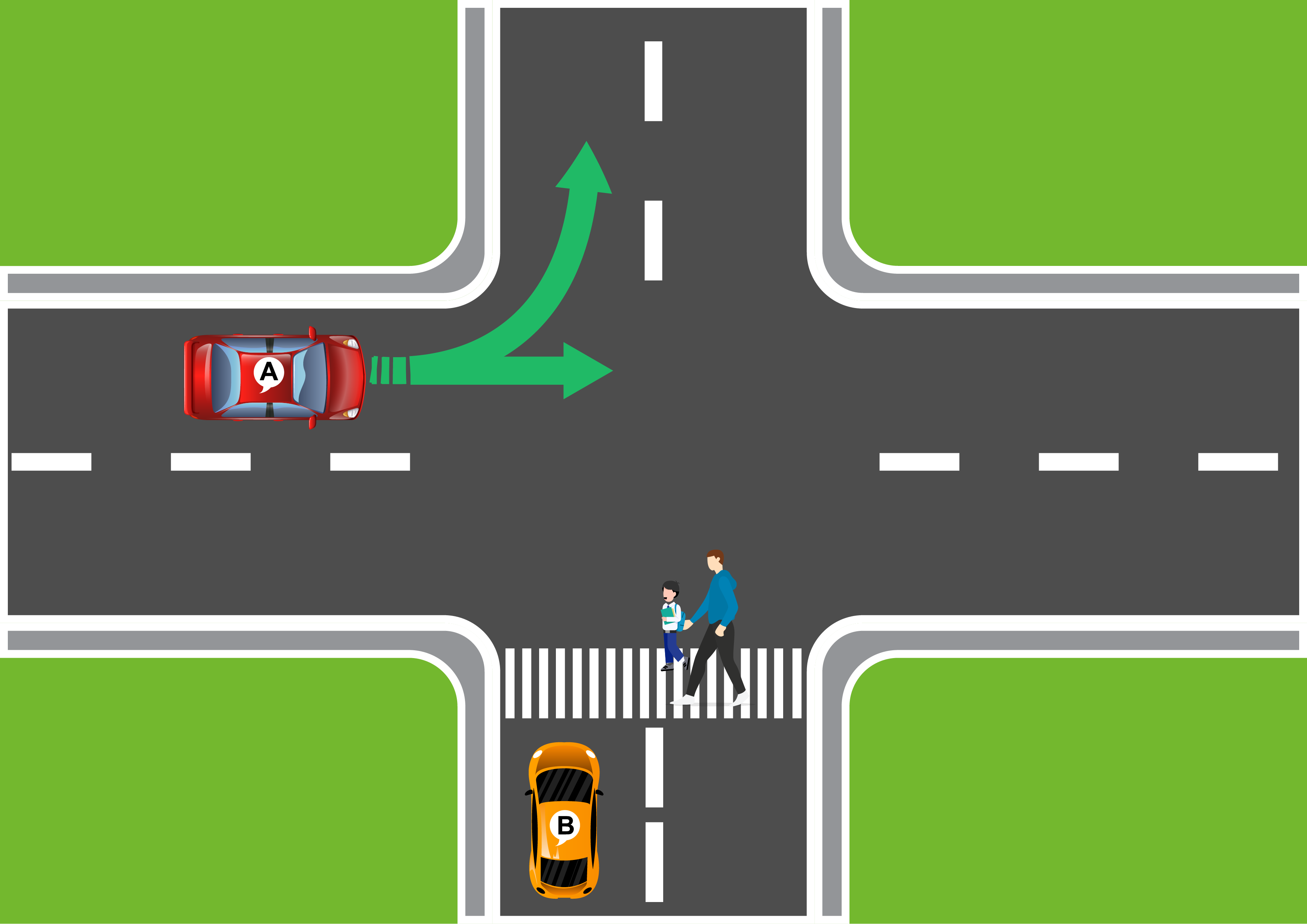
- Zebra crossings: reserved for pedestrians to cross safely,
highlighting their right of way.
Solid lines: indicate where changing lanes or overtaking is prohibited, such as near a curve or junction.
Dashed lines: Allow lane changes or overtaking when safe, but always check mirrors and blind spots before crossing.
Arrows and symbols: guide turning, merging, or lane-specific restrictions.
Figure 2: Example of a pedestrian crossing: Pedestrians have right of way. Car-B is stopped to let pedestrians cross.
Rationale: Road markings organize the available space, separate streams of traffic, and protect vulnerable road users. They reduce the need for constant enforcement by making the expected behavior obvious to all.
Traffic signals control movement at intersections, the points of
highest conflict in road networks. Standard meanings are:
- Red: stop completely and wait.
- Yellow/Amber: prepare to stop; do not accelerate to beat the
light.
- Green: proceed with caution when the way is clear.
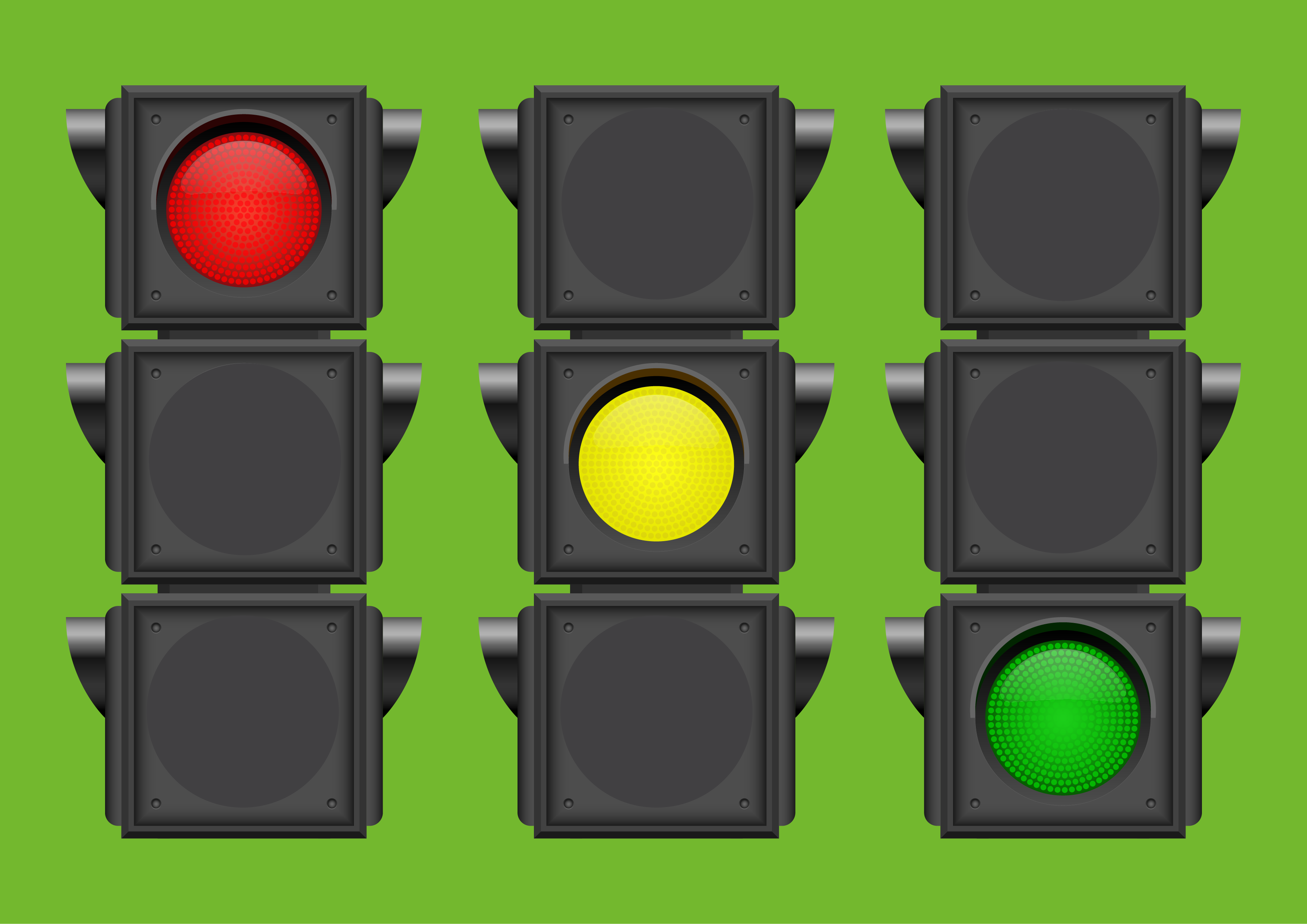
Figure 3: Example of Traffic Lights: Standard meanings show above.
Flashing signals often mean caution or a temporary condition, and at some intersections, police officers may override signals with hand instructions.
All-Red Phase: At some junctions, a brief 'all-red' period ensures
that the intersection clears before traffic in the next direction begins
to move. Never enter a junction during this phase.
Rationale: Signals create order in busy intersections, allowing vehicles
and pedestrians from different directions to move safely in turn. They
prevent the chaos of multiple vehicles trying to cross at once, and
reduce the likelihood of collisions.
| Golden Rule: Right of Way is not about power—it is about predictability. Always yield when required so that everyone knows what to expect. Yielding when required is also a sign of respect for others. |
|---|
Right of Way is an important concept in driving. Right of Way
rules clarify who should proceed first in different situations. They are
not about power or privilege, but about predictability and fairness.
When drivers know the order of precedence, hesitation and aggression are
reduced.
Examples:
At uncontrolled intersections: Vehicles approaching from the right have priority, as per Rule 27 of the Central Motor Vehicles Rules (CMVR).
At roundabouts: Vehicles already in the circle have priority; entering vehicles must yield.
Pedestrian crossings: Pedestrians have absolute right of way; stop fully to allow safe crossing.
Emergency vehicles: Always yield immediately to ambulances, fire engines, or police vehicles with active sirens and lights, pulling over to the left if needed.
Major vs. minor roads: Traffic on the major road has priority over vehicles entering from minor roads.
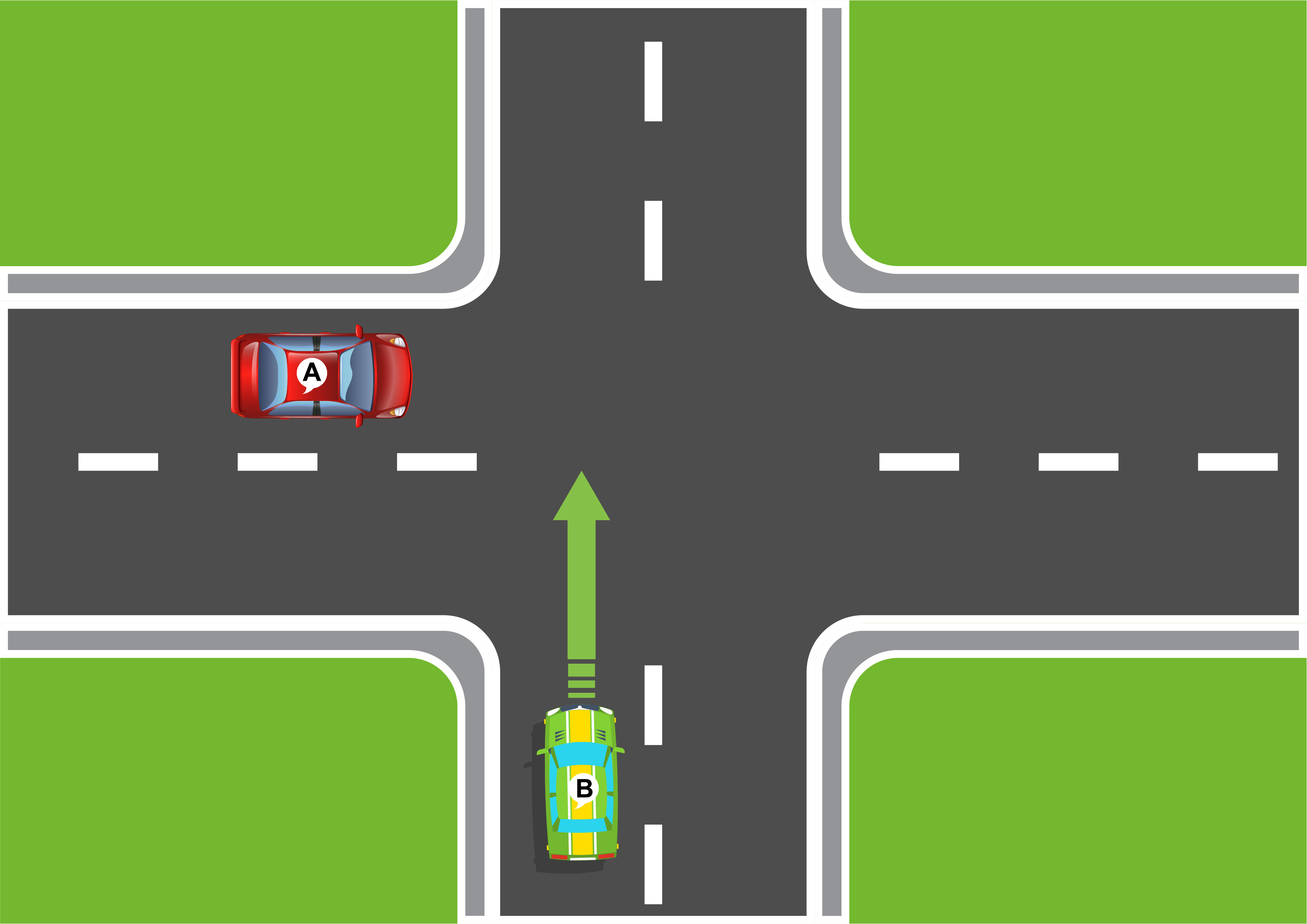
Figure 4: Uncontrolled intersection of two equal sized roads. The vehicles to your right has the right of way.
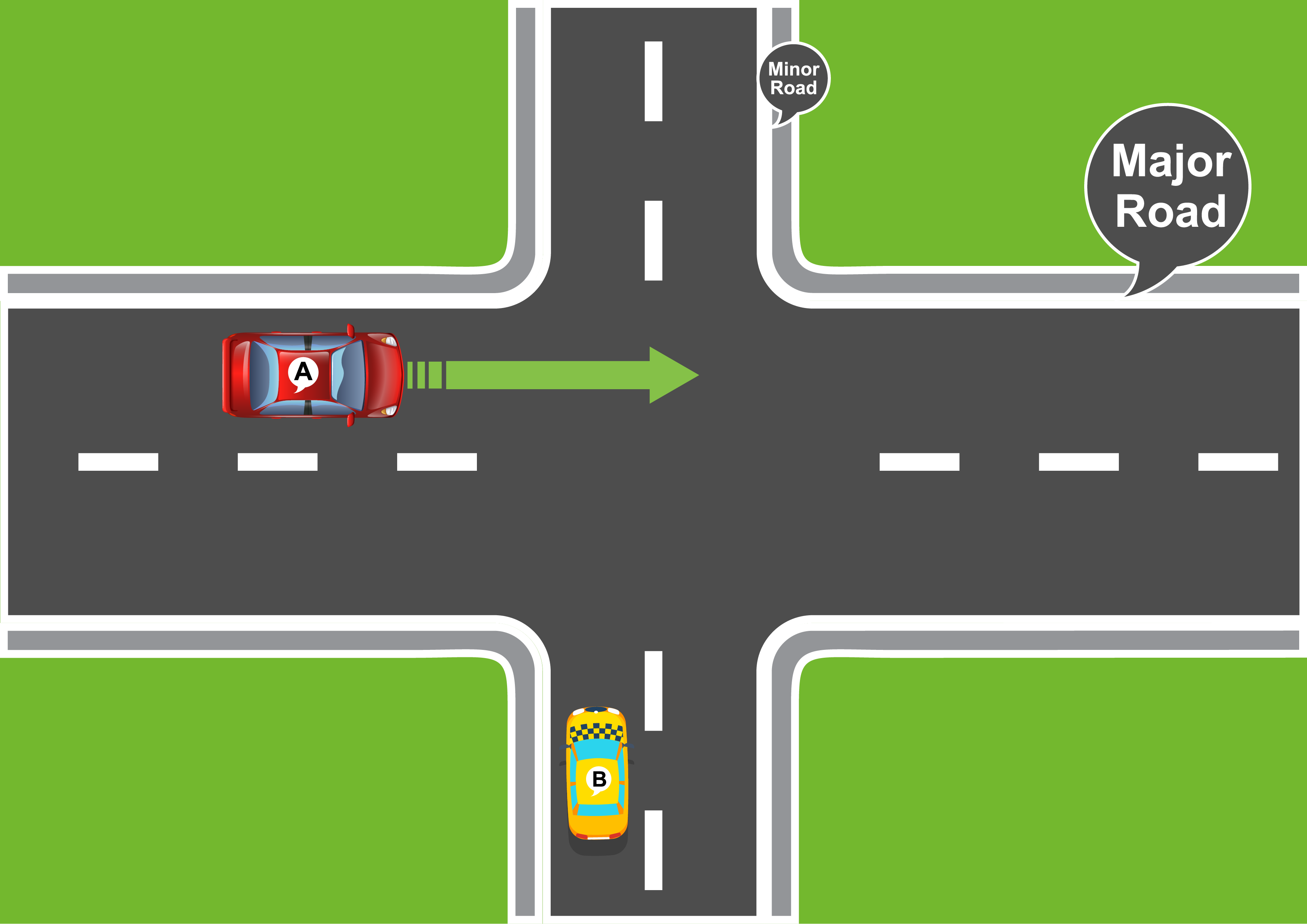
Figure 5: Uncontrolled intersection with a major and minor road. The traffic on the major road has right of way and the car-B on the minor road must stop and yield to all vehicles (traveling in either direction) traveling on the major road before entering the road.
Figure 6: Pedestrian Crossing: Pedestrians have right of way - car B stops and yields to pedestrians.
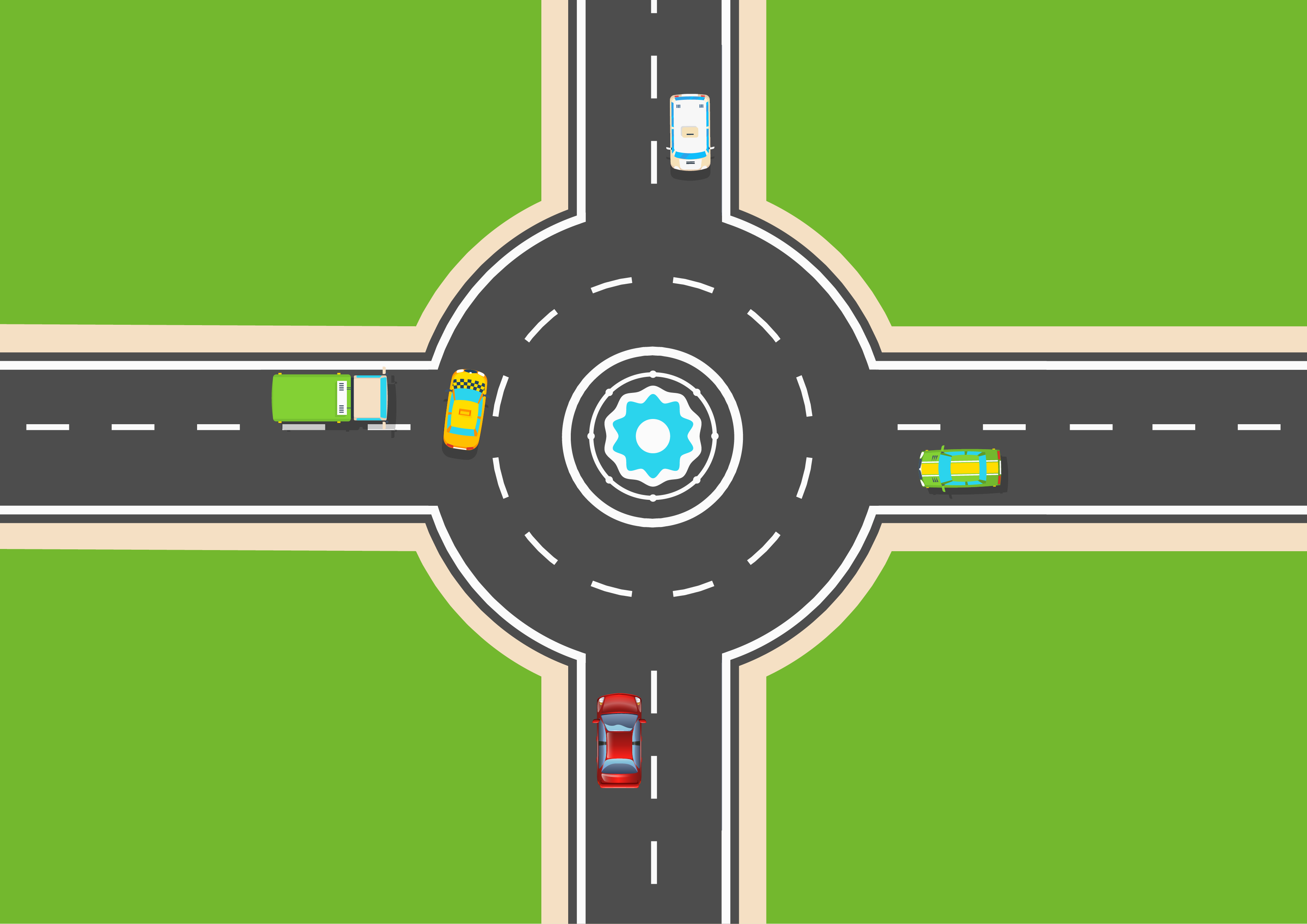
Figure 7: Roundabout - Traffic already in the roundabout has right of way. Green lorry (left) stops to yield to the yellow car (in the roundabout).
Rationale: Predictability is essential for safety. When every driver expects the same behavior, conflicts reduce and flow improves.
India follows the 'keep left' system. Drivers must keep to the left side of the road, leaving the right lane free for overtaking or for right turns. When the lanes are marked, the vehicle should stay in between the markings. Lane changes must always be signaled well in advance and carried out smoothly, without cutting across other vehicles. Good lane discipline makes driving less stressful for everyone.
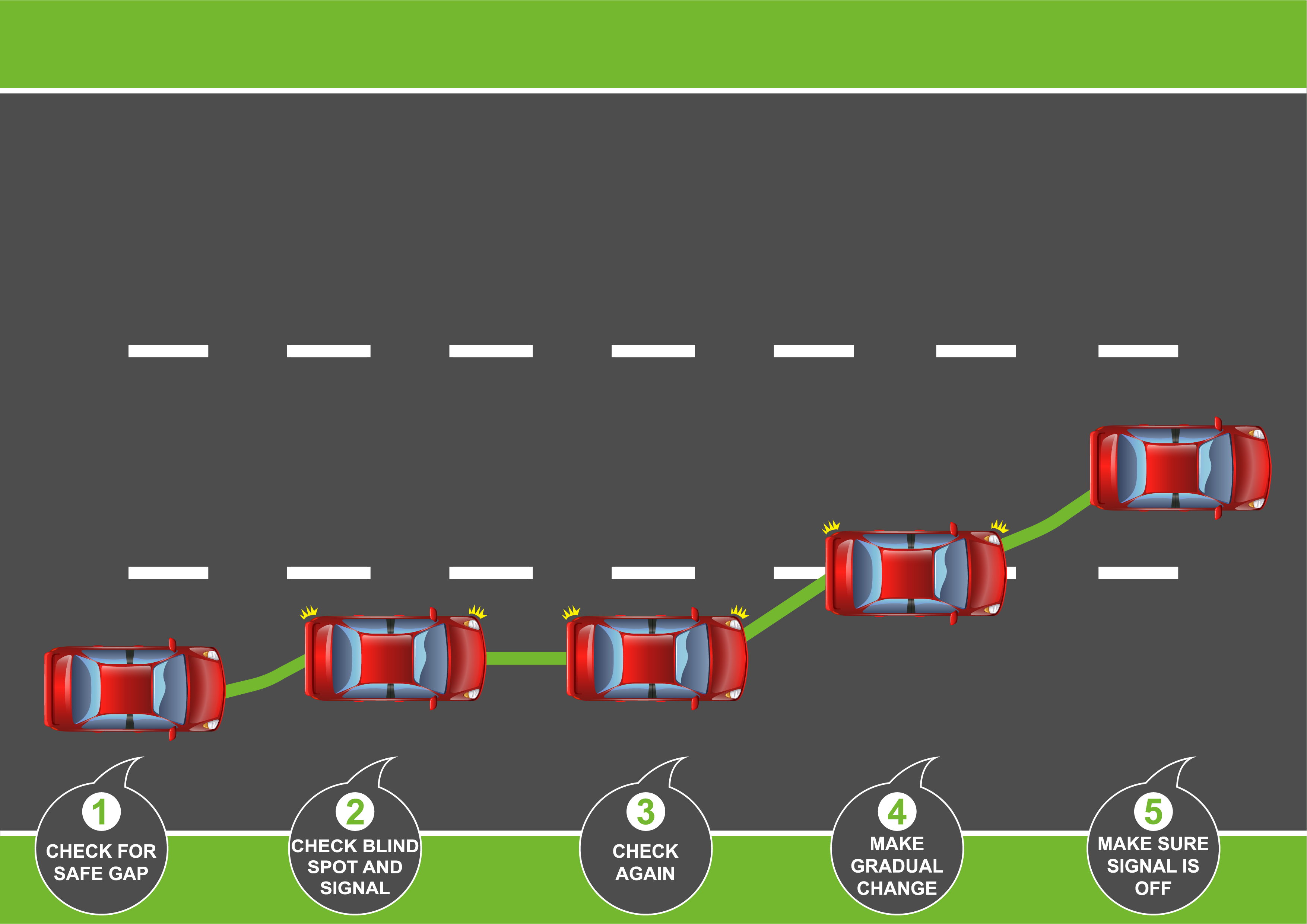
Figure 8: Safe method to change lanes. Follow the steps provided.
Rationale: Lane discipline ensures that traffic flows smoothly and predictably. Without it, weaving vehicles create constant surprises, which lead to sudden braking, near misses, and crashes. Staying in lane is both courteous and safe.
Reminder: Keep to the left except when overtaking. Avoid weaving between lanes. Always signal early when you intend to change lanes or turn. Overtaking must be done on the right. Do not overtake on the left unless the vehicle ahead is signaling a right turn and has moved to the center of the road.
Speed must always be adapted to road conditions. Posted speed limits are the maximum allowable, not a target in all situations. Drivers must reduce speed near schools, hospitals, markets, construction zones, or during rain and fog. A child running onto the road gives you only seconds to react—lower speeds give you those extra seconds. Modern enforcement tools like speed cameras and automated challans make speed control both a personal duty and a monitored legal requirement. Note that driving much slower than the flow of traffic on highways can also be dangerous by causing other drivers to change speeds and switch lanes to pass you.
Rationale: Stopping distance increases with speed, but reaction time does not. A car at 80 km/h needs nearly double the distance to stop as one at 50 km/h. Controlling speed gives drivers more time to react and avoids accidents.
Overtaking should only be done when it is safe, legal, and clearly communicated to others. On two lane roads, think of overtaking as borrowing the opposite lane—you must return it quickly and safely. Always overtake on the right after signaling. Check mirrors and blind spots before overtaking, and ensure a clear gap in oncoming traffic.
Never overtake:
- At bends or curves.
- Near hill crests.
- At intersections or pedestrian crossings.
- At railway crossings.
Rationale: You should not overtake where you cannot see ahead far enough
to be able to safely complete the overtake and return to your lane.
Overtaking requires moving into the opposite lane, often against
oncoming traffic. If visibility is limited, the risk of collision is
extremely high. The rules exist to prevent head-on crashes.
(a) Stopping
Stopping must never create obstruction or danger. Drivers should avoid stopping:
On pedestrian crossings.
At intersections.
On bends, bridges, or narrow roads.
At bus stops or in designated no-parking areas.
Rationale: Vehicles stopped carelessly reduce visibility, force others into dangerous maneuvers, and may block emergency access. Responsible stopping keeps roads safer and more orderly.
(b) Parking
Parking must never cause obstruction, danger, or inconvenience. Safe parking practices include:
• Park as close to the left edge of the road as possible, without blocking traffic.
• Always use the handbrake and switch off the engine when parked.
• At night, use parking lights or reflective warning if the vehicle is not easily visible.
• Do not double-park or leave your vehicle where it narrows the usable road.
• When leaving a parked position, check mirrors, signal, and re-enter traffic safely.
• Do not park in No-Parking zones.
• Do not park blocking entrances or exits when parking.
Rationale: Good parking not only avoids fines but also prevents accidents, ensures smoother flow, and shows consideration for other road users.
Horns and lights are safety tools, not weapons or toys. Horns should
only be used to warn others of potential danger, not to express
frustration or impatience. Using horns in silence zones such as
hospitals, schools, and courts is prohibited.
Lights serve two purposes: to see and to be seen. Proper use of
headlights improves your visibility at night, but it also ensures that
other drivers can see you clearly. High beams should only be used on
empty roads with poor lighting, and must be dipped when vehicles
approach. Hazard warning lights are only for situations when your
vehicle itself is a danger to others — such as breakdowns, accidents, or
when stopped unexpectedly in a dangerous spot. They must not be used
while driving in moving traffic, except in very limited circumstances
such as being part of an officially escorted convoy.
Rationale: Misusing horns increases noise pollution and stress, while
improper lighting blinds others and creates danger. Used properly, these
tools reduce accidents and signal courtesy to fellow road users.
Every driver has a general duty not to endanger or inconvenience
others. Beyond strict rules that must be followed, this means showing
civic sense, patience, and kindness:
- Yield when necessary to maintain flow.
- Stop for pedestrians even when it requires extra patience.
- Allow others to merge safely instead of blocking them.
- Avoid aggressive behavior or retaliating against mistakes.
Rationale: Roads are shared spaces. Courtesy and patience transform
driving from a stressful contest into a cooperative activity. Courtesy
is not weakness—it is strength that makes the road safer for all.
These do’s and don’ts turn safe driving principles into daily habits.
Do
• Obey all signs, signals, and road markings.
• Keep left and use lanes properly.
• Yield to pedestrians and emergency vehicles.
• Adjust speed according to conditions.
• Use lights correctly to see and to be seen.
• Use horns sparingly, only to warn of danger, and never in silence zones near hospitals or schools.
Don’t
• Overtake at bends, junctions, or crossings.
• Park in prohibited areas or obstruct traffic.
• Jump signals or ignore right-of-way rules.
• Use high beams carelessly at night.
• Misuse hazard lights when the vehicle is not in an emergency.
• Show aggression or impatience on the road.
Rules of the road bring order and safety to shared spaces.
Always obey traffic signs, signals, and markings.
Yield the right of way when required—predictability prevents crashes.
Follow safe overtaking, lane discipline, and speed limits.
Parking, use of lights, and signaling are part of safe road sharing.
Courtesy and patience turn rules into everyday safety practices.